Planning a Day Trip from Sofia to Rila Monastery: What to Expect
Setting Out from Sofia to the Rila Mountains
My typical weekday morning in Sofia starts with a quick espresso at a corner café along Vitosha Boulevard before the urban traffic gets going. Leaving the city behind for the granite peaks of the Rila range is a routine I never grow tired of. Planning a day trip from sofia to rila monastery is by far the most popular excursion for visitors in Bulgaria, yet executing it smoothly requires a few practical choices regarding timing and transport.
The journey spans roughly 120 kilometres south of the capital, taking just under two hours by car or organized shuttle. Entrance to the main courtyard and central church is completely free of charge, making this one of the most accessible cultural heritage sites in Southeastern Europe. You only need cash if you plan to visit the history museum on-site, which costs 8 BGN (around €4) for adults, or if you want to sample fresh mountain trout at the small riverbank taverns nearby.
Morning Departure Logistics and Timing
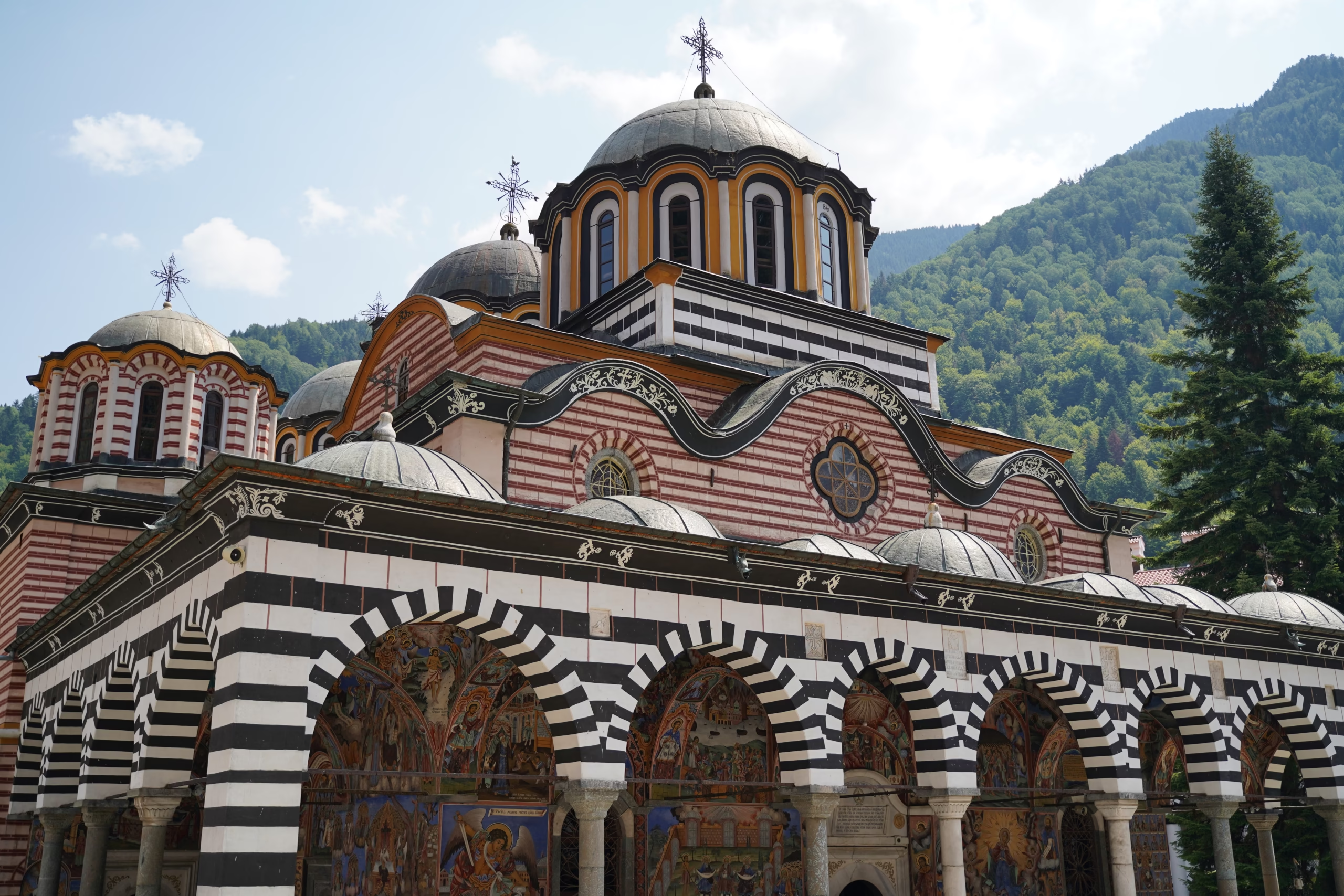
Timing your departure is the single most important factor for a relaxed visit. Tour coaches from Sofia generally pull up between 11:30 AM and 12:00 PM, spilling hundreds of day-trippers into the inner courtyard at once. Setting out by 08:00 AM ensures you arrive right as teh morning light strikes the black-and-white striped arcades, long before the crowds gather.
If you prefer not to drive, direct daily shuttle services operate from Alexander Nevsky Cathedral. Independent travelers often opt for a Rila Monastery and Boyana Church Full-Day Tour, which combines two UNESCO landmarks into a single organized run. Those who want extra time on forest trails can look into a Rila Monastery and St. Ivan Cave History & Nature Trip. Detailed breakdowns on bus timetables and car hire routes can be found on our transportation guide.
Driving Route and Changing Landscapes
The drive begins on the Struma Highway (A3), heading south toward Greece. Concrete suburban apartment blocks give way to wide open agricultural plains framed by the Vitosha and Verila mountain ranges. After roughly 60 minutes, you take the exit toward Dupnitsa and Kocherinovo, where the road turns east into the Rilska River valley.
From Kocherinovo onward, the route narrows significantly. You wind through small rural villages like Pastra, where roadside stalls sell jars of local forest honey and wild berry preserves. The air cools rapidly as dense beech forests close in around the tarmac, signaling your ascent into the high-altitude territory of the Rila Nature Park.
First Impressions of the Monastery Walls
The monastery appears suddenly after a sharp bend in the mountain road. From the outside, the complex resembles a massive medieval stone fortress, complete with high defensive walls, heavy oak iron-studded gates, and small defensive windows. This grim exterior was designed deliberately to protect the monastic community from Ottoman raiders during centuries of occupation.
Step through the Dupnitsa Gate early in the morning. The quiet echo of mountain water falling into the stone fountains sets a tone of deep stillness before the daily tourist buses arrive.
Passing through the thick archway of the Dupnitsa Gate presents an extraordinary visual contrast. The dark stone exterior immediately opens up into a vast paved courtyard surrounded by four levels of residential balconies painted in bold black, white, red, and yellow patterns. At the centre stands the fourteenth-century stone defence tower known as Hrelyova kula (Hrelyu’s Tower) alongside the primary church.
Inside the Courtyard and the Nativity Church
Is the Rila Monastery worth visiting? As Bulgaria’s most famous monastery and its primary spiritual sanctuary, the site holds deep historical weight. The central church, known as the Cărkva Rozhdestvo Bogorodichno (Church of the Nativity of the Virgin), sits squarely in the middle of the courtyard. Its outer portico is lined with black and white striped arches housing hundreds of vivid religious paintings.
Inside the main sanctuary, electric lights are replaced by soft candlelight flickering against an enormous gilded wood-carved iconostasis. The air carries the dry fragrance of burning frankincense and old beeswax. Photography is strictly prohibited inside the inner church to preserve the historic interior paintings. For an overview of sacred art and regional religious context, explore our guide on Bulgarian Eastern Orthodoxy.
Architectural Details and Zahari Zograf’s Frescoes
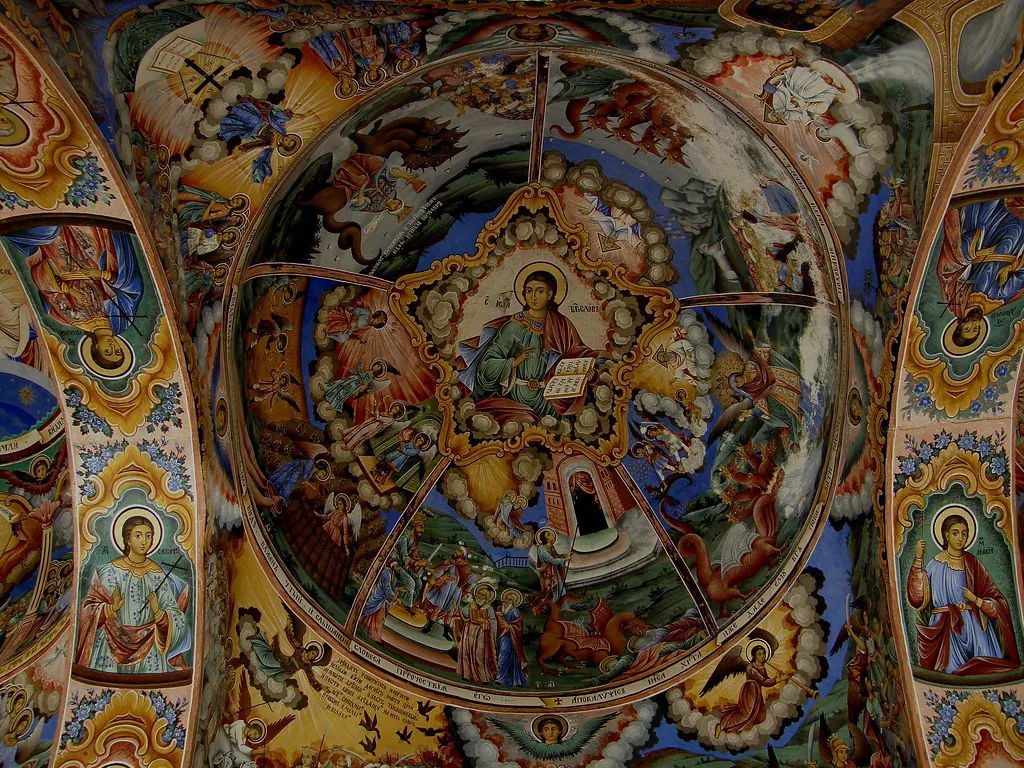
The exterior wall paintings along the church porch were executed by Master Zahari Zograf, a leading figure of the nineteenth-century Bulgarian National Revival period. Zograf painted detailed scenes depicting the Last Judgment, angels, demons, and moral allegories meant to instruct visitors passing through the portico.
Taking time to examine these panels reveals subtle social critiques of the era. Merchant figures in contemporary Ottoman-era clothing appear alongside tormenting demons, while Zograf tucked a modest self-portrait of himself into a top corner. Readers curious about the deeper artistic history can read our essay on monastery architecture and frescoes.
Exploring the On-Site Museum and Raphael’s Cross
Adjacent to the courtyard stands the ecclesiastical history museum. While entry to the main grounds requires no fee, the museum ticket gives access to a collection of silver reliquaries, medieval weapons, royal charters granted by Bulgarian czars, and rare church vestments woven with gold thread.
The museum’s central masterpiece is Rafailova krăst (Raphael’s Cross). Carved out of a single piece of dense boxwood by a monk named Raphael, the cross measures just 81 by 43 centimetres yet contains 104 religious scenes and 650 miniature figures. Monk Raphael spent twelve years working on the piece using fine magnifying lenses before losing his eyesight completely in 1802 upon its completion.
Midday Fuel: Mountain Trout and Local Pastries
Sightseeing works up an appetite, and the area around the complex offers classic mountain fare. Just behind the rear Samokov Gate sits a tiny monastic bakery. Local visitors queue early for hot mekitsi (fried dough pastries dusted with powdered sugar and served with local buffalo yogurt or wild blueberry jam).
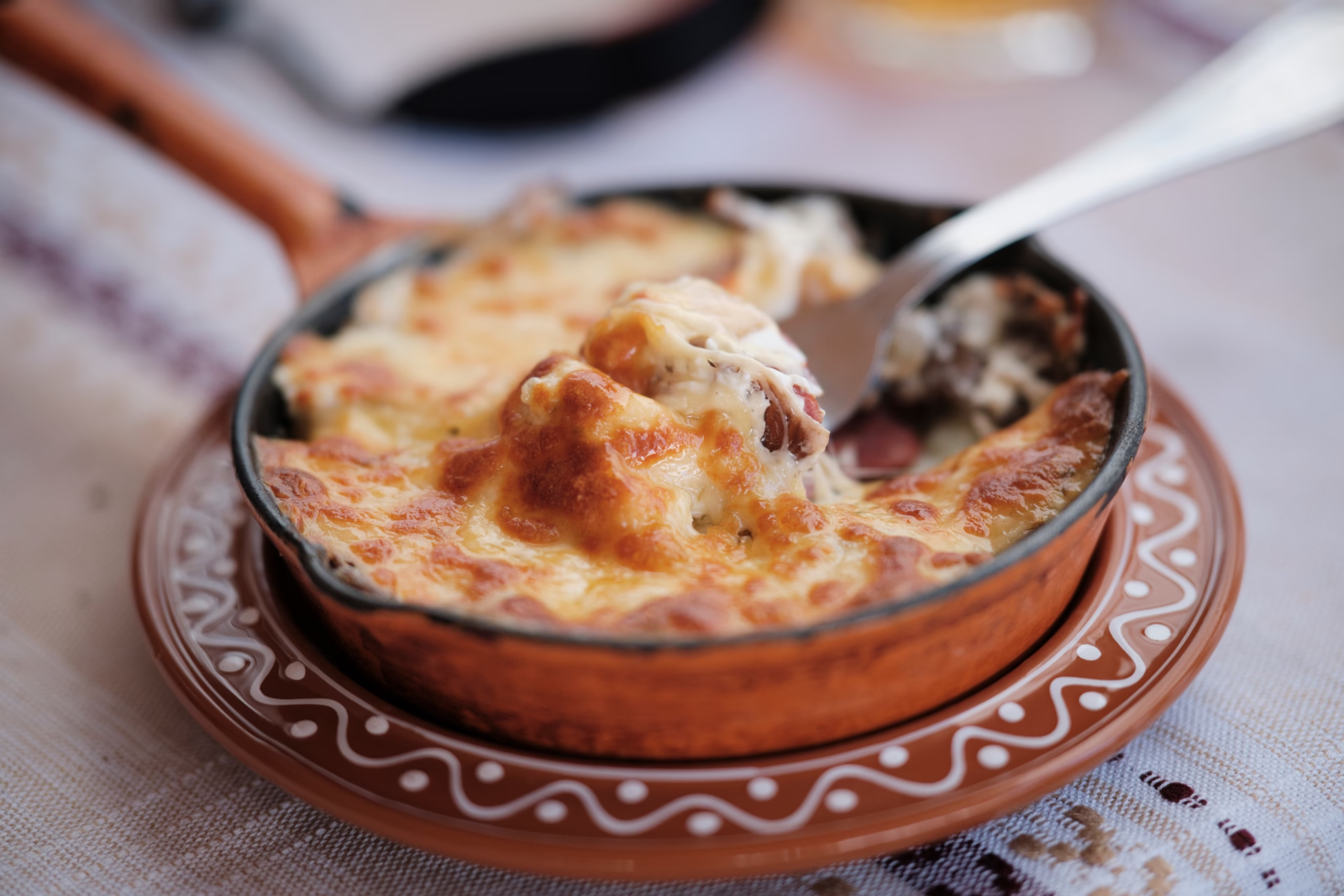
For a full meal, cross the wooden footbridges over the Rilska River right outside the northern wall. Several rustic taverns specialize in fresh păstrăv (grilled river trout cooked over open embers with garlic oil and lemon). Pair the fish with a hot clay-pot dish like sirene po shopski (baked white cheese with tomatoes and egg) for an authentic taste of mountain cuisine.
Afternoon Hike to Saint Ivan’s Cave
A short four-kilometre drive up the asphalt road behind the monastery brings you to the start of the trail leading to Peshtera na Sveti Ivan Rilski (the Cave of Saint Ivan of Rila). Saint Ivan founded the monastic community in the tenth century, living as an ascetic in a natural stone cavity high above the valley floor.
The dirt path ascends gently through ancient beech trees, taking roughly 25 minutes on foot. At the cave entrance, pilgrims light candles inside a dark stone alcove before climbing a vertical rock chimney at the rear. Local tradition holds that anyone able to fit through the narrow stone chimney is cleansed of sin. It is a peaceful, cool forest retreat that provides a quiet spot I always like to walk to.
Practical Visitor Rules and Overnight Possibilities
Visiting a sacred working site requires modest behavior. Shorts, sleeveless tops, and short skirts are strictly forbidden inside the church and courtyard. If you arrive in summer clothes, guards at the gate will ask you to wrap a scarf around your legs or shoulders. Detailed dress guidelines are outlined on our visitor rules page.
Can you sleep in Rila Monastery? Yes, simple guest rooms known as monastirski kilii (monk cell accommodations) are available for travelers seeking quiet overnight stays. Rooms are sparse, equipped with basic wooden beds, shared bathrooms, and no heating outside mid-winter, offering a rare opportunity to experience dusk and dawn inside the empty complex. Reservations must be arranged via phone or on-site with the monastic office. Further details on guided day visits are listed on our tickets and tour guide.
Realistic Day Trip Timeline from Sofia
This hour-by-hour schedule reflects a comfortable pace for independent travelers exploring by rental car or private shuttle, avoiding the rush while squeezing in a forest hike and local meal.
- 08:00 AM – Depart central Sofia, heading south via Struma Highway (A3).
- 09:45 AM – Arrive at Rila Monastery; park near the main eastern gate.
- 10:00 AM – Explore the main courtyard, Nativity Church frescoes, and Hrelyu’s Tower in peace.
- 11:30 AM – Tour the Ecclesiastical History Museum to view Raphael’s Cross.
- 12:30 PM – Lunch at riverside taverns behind the monastery gate; pick up fresh mekitsi.
- 01:45 PM – Drive 5 minutes up valley to the trail for Saint Ivan’s Cave; walk through the forest.
- 03:30 PM – Return to the courtyard for afternoon photographs and quiet reflection.
- 04:30 PM – Begin the return drive toward Sofia.
- 06:30 PM – Arrive back in central Sofia in time for dinner.
Beyond Rila Monastery
While a day trip from sofia to rila monastery is the centerpiece of many itineraries, Bulgaria holds a dense network of geological landmarks and cultural reserves within driving distance. Connecting your rila monastery trip from sofia with nearby regions expands your view of the country’s diverse landscapes, from deep limestone caverns to National Revival towns. Learn more on our roundup of beautiful places across Bulgaria.
Top Nearby Spots Comparison
| Attraction Name | Type | Region / Location | Notable Feature |
|---|---|---|---|
| Melnik Earth Pyramids | Natural Landmark | Melnik, Blagoevgrad | Sandstone formations surrounding Bulgaria’s smallest wine town |
| Rozhen Monastery | Monastery | Pirin Mountains | Secluded mountain sanctuary with carved wooden iconostasis |
| Prohodna Cave | Natural Landmark | Karlukovo, Lovech | Massive karst chamber featuring two eye-shaped ceiling openings |
| Devetashka Cave | Cave | Devetaki, Lovech | Colossal cave hall with giant natural skylights and bat colonies |
| Devil’s Throat Cave | Cave | Trigrad, Rhodopes | Subterranean waterfall linked in folklore to Orpheus |
| Yagodinska Cave | Cave | Yagodina, Rhodopes | Three-tier cave system containing delicate cave pearls |
| Uhlovitsa Cave | Cave | Uhlovitsa, Smolyan | Ancient cave featuring rare corallite flowstone formations |
| Basarbovo Rock Monastery | Monastery | Basarbovo, Ruse | Active cave monastery carved straight into a cliffside wall |
| Villa Armira | Archaeological Site | Ivaylovgrad | Opulent Roman villa preserved with intricate floor mosaics |
| Zheravna Reserve | Cultural Heritage Site | Zheravna, Sliven | Historic village with over 200 preserved wooden Revival homes |
Highlights Around the Region
Subterranean Caverns and Gorges
North toward Lovech, Prohodna Cave stands out for its huge natural ceiling arches known as “The Eyes of God.” Further east in the same district, Devetashka Cave features immense dome skylights and thousands of resident bats. Deep in the southern Rhodope Mountains, Devil’s Throat Cave houses the highest underground waterfall in the Balkans, while Yagodinska Cave offers subterranean passages filled with fragile stone draperies. Near the southern border, Uhlovitsa Cave rewards visitors with glowing white corallite formations.
Historic Enclaves and Architectural Gems
Farther south near the Greek border, the Melnik Earth Pyramids surround Bulgaria’s smallest town, famed for dark red Broad-Leaved Melnik wine. Nearby Rozhen Monastery sits quietly among the ridges of the Pirin range. Travel north toward the Danube River to find Basarbovo Rock Monastery carved into vertical cliffs along the Rusenski Lom. In the far east, Zheravna Architectural Reserve features hundreds of timber houses, while Villa Armira showcases pristine Roman marble mosaics.
Getting Around
Reaching these regional highlights requires planning. While daily shuttle buses connecting Sofia and Rila are reliable, secondary sights like Devetashka Cave, Melnik, or the Rhodope gorges are far more convenient to reach with a private rental car. Having your own vehicle allows you to link the monastery with side trips across southwestern Bulgaria without relying on sparse regional bus connections.
If you prefer guided transport with logistics handled for you, small group day trips remain a hassle-free option. Popular itineraries such as the 7 Rila Lakes and Rila Monastery Tour combine alpine hiking with cultural sightseeing in a single efficient route. For official cultural schedules and regional event updates, check the Official Tourism Portal of Bulgaria or review UNESCO’s designation details on the UNESCO World Heritage Centre site.